Air conditioner running costs depend on the electricity the equipment uses, how long it operates and the tariff applying during those hours. The cooling capacity printed in a product name is not the same as its electrical input. Confusing the two can produce a very misleading estimate.
A useful calculation makes its assumptions visible. It should help you compare scenarios, not pretend to predict an exact Brisbane electricity bill. Equipment, weather, room conditions and the household's tariff all affect the result.
Use electrical input, not the cooling capacity label
A unit described as providing several kilowatts of cooling is stating useful cooling output under specified conditions. Its electrical input is a different value. An inverter can vary its operation, so actual consumption may change over a session rather than remain at one fixed figure.
The Zoned Energy Rating Label and manufacturer information help compare appropriate equipment. A room still needs a suitable capacity assessment. Selecting a smaller number purely to reduce a theoretical cost can leave the space uncomfortable.
Apply the basic energy calculation
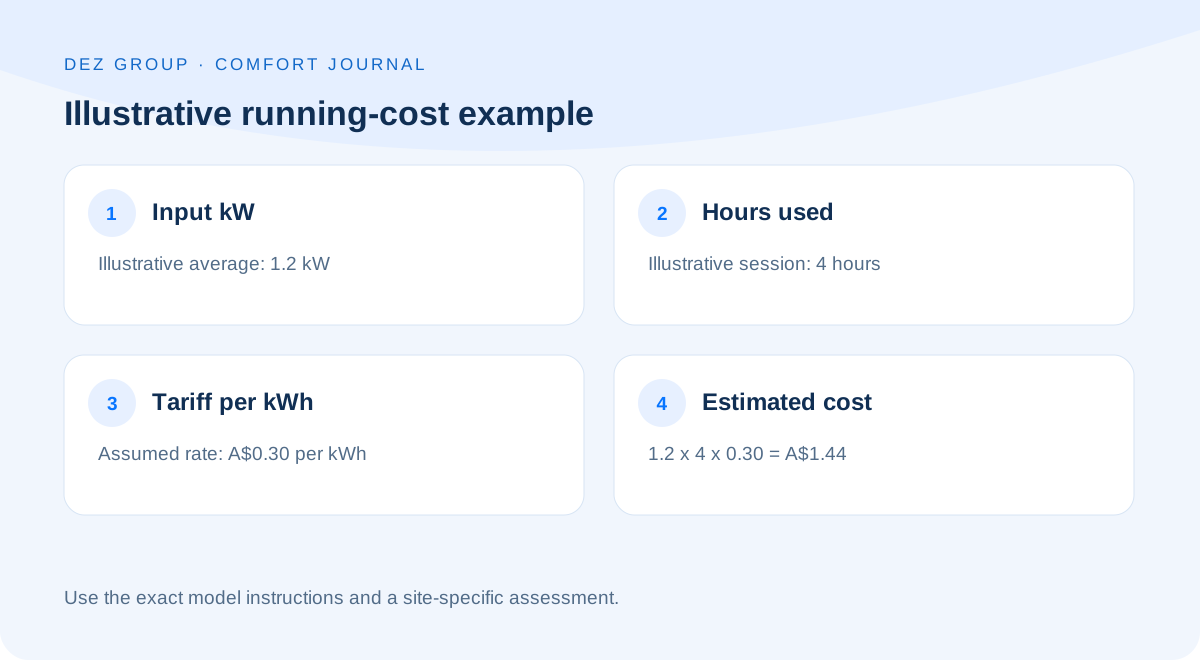
For a simple illustrative scenario, energy in kilowatt-hours equals average electrical input in kilowatts multiplied by operating hours. The energy cost then equals those kilowatt-hours multiplied by the relevant price per kilowatt-hour.
Suppose a hypothetical system averages 1.2 kW of electrical input over a four-hour session. It would use 4.8 kWh in that example. If the assumed tariff were A$0.30 per kWh, the energy charge for the session would be A$1.44. These are demonstration inputs, not a current Brisbane tariff or a claim about a particular unit.
| Illustrative input | Value |
|---|---|
| Average electrical input | 1.2 kW |
| Operating period | 4 hours |
| Calculated energy | 4.8 kWh |
| Assumed tariff | A$0.30 per kWh |
| Calculated session energy charge | A$1.44 |
Daily supply charges, demand charges where applicable and other bill components are outside that simple session calculation. Do not present the result as the entire cost of having electricity connected.
Match the tariff to the operating period
Use your own retailer's tariff information and bill. A flat tariff and a time-of-use tariff can give different results for the same amount of energy. If a session crosses tariff periods, calculate the energy in each period separately rather than using one convenient rate for the whole session.
Controlled-load arrangements, demand charges and solar export considerations can require a more detailed comparison. Solar generation is not automatically free cooling: using energy in the home may change what is available to export. Describe the assumptions rather than assigning a universal saving to daytime operation.
Understand why real consumption changes
Room heat gain, outdoor conditions, set point, humidity, occupancy and air leakage all influence the work required. A hot room being cooled for the first time that day may behave differently from the same room maintaining a stable condition later.
Maintenance and airflow can also matter, but a single cleaning task does not justify a guaranteed percentage saving. Use the summer settings guide to consider shading, air movement and reasonable operation alongside the equipment itself.
Measure carefully where suitable
For equipment that is permanently wired, do not insert an improvised meter or alter the electrical connection. Ask an appropriately qualified person about suitable measurement options. Whole-home monitoring can provide context, but other appliances must be considered when attributing consumption to the air conditioner.
A measured period is still a sample of particular conditions. Compare similar weather and use where possible. Recording mode, hours and the rooms conditioned can make the numbers more useful than comparing two electricity bills from different seasons without context.
Use the estimate to ask better installation questions
Compare systems serving the same comfort brief, with relevant efficiency information and realistic operating hours. Ask how sizing, zoning or room improvements affect the design. A cheaper purchase price and a lower running cost are separate questions.
DEZ Group can discuss installation options and maintenance for your Brisbane property. Request a quote with your room-use pattern if you are considering a replacement, and keep energy estimates clearly separated from promises about future bills.
Common questions
Does a 5 kW air conditioner use 5 kWh every hour?
Not simply because of that model description. The advertised figure commonly refers to cooling output. Electrical input and actual operation need separate information.
Can I multiply one hourly cost by the whole summer?
Only as a clearly labelled scenario. Actual hours, weather, tariffs and average input can change substantially. A precise-looking total is not a forecast unless its assumptions are supported.
Does a higher star rating always mean a lower bill than any other unit?
Compare similar capacities, features and climate information. A larger unit and a smaller unit can have similar ratings while using different amounts of energy to serve different spaces.